 Slidr Team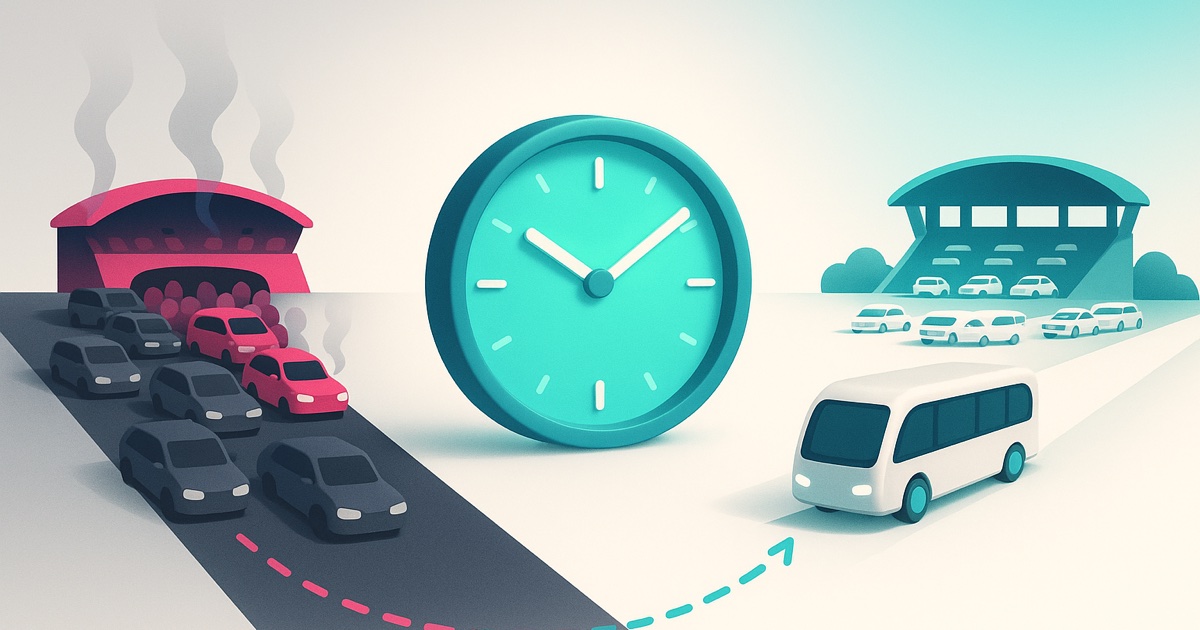
Game day shuttle logistics require coordinating thousands of fans across constrained parking and traffic. Electric microtransit solves this with capacity, speed, and zero emissions.
Game day shuttle logistics refers to the coordinated movement of large crowds of sports fans from parking areas, hotels, and transit hubs to stadiums and venues on single high-traffic days. Universities hosting football games can expect enormous crowds within a few hours, creating acute transportation challenges that traditional bus systems struggle to handle. A single well-managed shuttle program can meaningfully reduce game-day parking demand, eliminate traffic gridlock around stadiums, and generate positive community sentiment while meeting sustainability goals. The challenge is not whether to offer game day shuttles, it is whether you can scale operations efficiently without permanent infrastructure investment or staff overhead.
Why Game Day Shuttle Logistics Matter for Universities
Stadium parking is expensive to build and maintain. Every new parking space is a real construction cost for universities, and game day traffic often forces schools to open remote lots far from campus. This creates a poor fan experience, consumes police resources for traffic control, and generates complaints about accessibility.
Sustainable alternatives exist. Electric game day shuttles move fans by the vanload, which means one shuttle running continuously through game day can move a large crowd without requiring new pavement. The math is simple: fewer cars on campus streets means fewer traffic incidents, faster police response times for actual emergencies, and a perception of operational sophistication.
Emissions matter too. A single game with tens of thousands of fans arriving by car generates a large amount of CO2. Shifting even a modest share of that volume to electric shuttles removes a meaningful amount of those emissions in a few hours.
Game Day Shuttle Logistics: Operational Framework
Moving thousands of fans requires three things: predictable vehicle placement, driver coordination, and real-time demand management. Most universities attempt this with aging fixed-route buses, which break down under peak load and waste capacity on low-traffic periods.
Dynamic routing solves this. Instead of buses following fixed schedules, vehicles position themselves at the highest-demand zones and move fans as soon as the vehicle is full. This sharply reduces average wait times. Apps with real-time tracking eliminate the uncertainty that discourages fans from using shuttles in the first place.
The UNA Roar Ride program in Florence, Alabama demonstrated this principle. When first-semester data showed higher demand for flexible rides, Slidr moved from 1 fixed-route vehicle and 2 on demand to 1 fixed-route vehicle and 3 on demand, and ridership doubled in the second semester. Over the academic year, the program served 8,448 total riders.
Turnkey operators handle the complexity. Vehicle sourcing, driver hiring, insurance, maintenance, routing algorithms, and customer support are managed as a single operation. Universities do not have to manage these separately, which reduces the timeline from planning to launch by months.
Capacity Planning: Matching Vehicles to Demand
Game day demand is not uniform. Fan arrival clusters in the hours before kickoff and disperses rapidly after the final whistle. Smart operations position vehicles in waves, matching supply to predicted demand.
Small campuses need only a handful of electric shuttles to handle peak load. Mid-size stadiums require a larger mixed fleet, and the largest programs need a substantial fleet that includes mid-size buses. These fleet sizes assume dynamic routing and full vehicles on outbound trips.
Vehicle type matters. A typical small electric shuttle (GEM or VW ID. Buzz) works for smaller crowds. Larger stadiums benefit from mid-size electric shuttle buses because they reduce the number of individual trips required. Oberlin, Ohio deployed a single high-capacity vehicle that moved 28,264 passengers in 12 months, demonstrating that electric shuttles are not toys, they are serious transit infrastructure.
| Stadium Size | Expected Attendance | Recommended Vehicles | Est. Fans Moved/Hour (Peak) |
|---|---|---|---|
| Small | Smaller crowds | A few small shuttles | Moderate |
| Mid-size | Larger crowds | A mixed fleet | Higher |
| Large | The largest crowds | A large fleet incl. mid-size buses | Highest |
Sustainability as a Messaging Tool
Electric game day shuttles reduce emissions and air quality concerns, but they also communicate institutional values to students, families, and donors. Universities increasingly market sustainability as a differentiator in recruitment. Prospective students notice when a school takes environmental commitments seriously, and game day is a high-visibility moment.
FSU's Safe Ride program in Tallahassee prioritizes both safety and emissions reduction. By offering free, electric-powered transportation, the program removes impaired drivers from the road while demonstrating institutional responsibility to the surrounding community.
The business case is strong: avoided parking infrastructure costs, reduced traffic management overhead, and enhanced institutional brand reputation. Over time, these benefits often exceed the cost of operating the shuttle program. That operating cost is driven by fleet size, service hours, vehicle type, and service model. Discuss your project.
Technology Infrastructure for Game Day Success
Real-time dispatch and passenger tracking are non-negotiable for game day operations. Drivers need live demand signals so they can reposition without guessing. Passengers need transparent wait time estimates so they make informed decisions about using shuttles versus alternatives.
Mobile apps integrate real-time vehicle location, capacity status, and estimated arrival times. This transparency converts skeptical fans into repeat shuttle users. CatawbaGO at Catawba College in Salisbury, NC proved this at scale: the program generated 13,696 rides from Aug 20, 2025 to Sep 30, 2026 (as of September 2026) by combining reliable vehicles with intuitive app-based booking.
Data analytics inform season-over-season improvements. Which pickup zones generated the longest wait times? Which time windows had the lowest occupancy rates? Which vehicle types performed best? These insights drive operational refinement that increases ridership and reduces per-passenger costs.
Frequently Asked Questions
How do we avoid long wait times when thousands of fans are waiting for shuttles?
Dynamic routing and sufficient vehicle density eliminate queues. If your system maintains a short maximum wait time as a design target, you position vehicles in advance based on predicted demand and real-time data, ensuring fans are not standing around. Cove Inn Naples' guest shuttle completed 1,136 rides and carried 2,626 passengers from March 4 to September 27, 2026 (as of September 2026), a sign that responsive on-demand service is achievable with the right operational model.
Can we run game day shuttles without hiring dedicated staff?
Yes, if you use a turnkey operator. Turnkey providers like Slidr handle driver sourcing, scheduling, training, and compliance. You do not build internal staff; the operator scales staff up and down based on your needs. Many universities run game day shuttle programs with zero additional internal employees.
What if our stadium is not in an urban area and fans are scattered across a large geographic area?
Wider geographic areas require more vehicles but the same operational principles apply. You establish regional hub zones (hotel clusters, major parking areas, satellite lots) and run shuttle routes between hubs and the stadium. Technology and data help you identify which hubs generate the most demand so you position vehicles accordingly.
The Path Forward
Game day shuttle logistics will become table stakes for universities. Demographic shifts, climate expectations, and operational efficiency demands are converging on the same conclusion: traditional fixed-route buses and distributed parking lots are inefficient artifacts. Electric microtransit systems that scale dynamically, respond to real-time demand, and generate transparency through apps represent the next generation of campus transportation. Universities that implement these systems now will build operational muscle and community confidence. Those that delay will eventually face the same choice at higher cost and with fewer proven models to reference.