 Slidr Team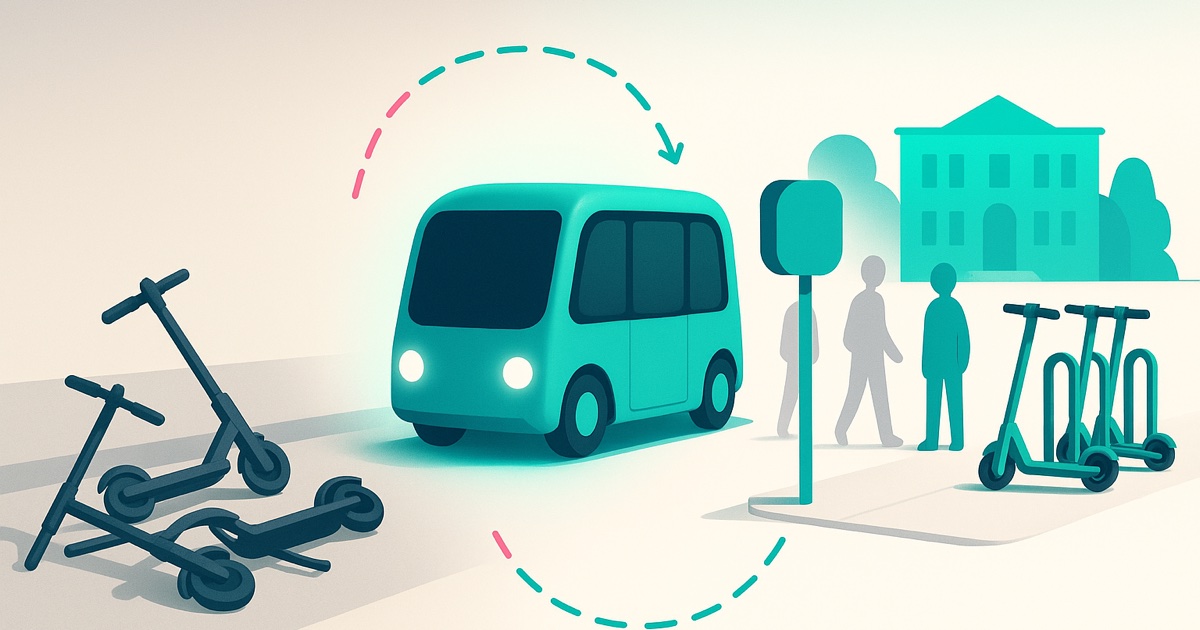
A head-to-head comparison of dockless scooter programs and managed electric shuttle services for college campuses, covering safety, accessibility, cost, and institutional control.
In recent years, college campuses have become testing grounds for every flavor of electric micro-mobility. Dockless scooter companies such as Bird, Lime, Spin, and Veo flooded university districts beginning in 2018, while a growing number of schools have simultaneously invested in managed electric shuttle programs. Both approaches promise to reduce car dependency, shrink campus carbon footprints, and improve student mobility. But the two models differ dramatically in safety outcomes, accessibility, cost structure, and the degree of control an institution retains.
At Slidr, we operate managed electric shuttle fleets on campuses nationwide, so we obviously have a perspective. But we also recognize that some campuses benefit from a hybrid approach. This article lays out an honest, data-driven comparison so administrators, student government leaders, and sustainability directors can make an informed decision.
Safety: The Numbers Tell a Clear Story
The Consumer Product Safety Commission reported a large number of emergency room visits related to e-scooters and e-bikes between 2017 and 2022 in the United States. Injuries involving micromobility products rose sharply over that period in the same Consumer Product Safety Commission data (CPSC), with e-scooters showing the sharpest rise and head injuries accounting for a significant share. Helmet usage on shared scooters remains stubbornly low among riders in most university-adjacent markets.
Managed electric shuttles, by contrast, are operated by trained, licensed drivers. Passengers sit in enclosed or semi-enclosed vehicles traveling at low speeds. Collision rates are negligible, and injury rates are orders of magnitude lower per passenger-mile. For a university risk management office, the difference in liability exposure is substantial. Schools that permit dockless scooters on campus often inherit indirect liability when injuries occur on university property, even if the scooter company carries its own insurance.
Accessibility and ADA Compliance
This is arguably the most important distinction and the one that receives too little attention. Electric scooters are inherently inaccessible to students with mobility impairments. A student who uses a wheelchair, walks with a cane, or has a visual impairment simply cannot use a scooter. Under the Americans with Disabilities Act, universities that promote or officially sanction scooter programs as campus transportation may face questions about whether they are providing equitable mobility options for all students.
Electric shuttles, when properly configured, accommodate wheelchairs, walkers, and service animals. Slidr vehicles are ADA-compliant, and our on-demand model means students with disabilities receive the same real-time pickup experience as every other rider. This is not a marginal concern. Many undergraduates live with a disability.
Weather and Seasonal Reliability
Scooters are fair-weather devices. Rain, ice, snow, and even strong wind render them impractical or dangerous. Campuses in the Midwest, Northeast, and mountain regions may see scooter utilization drop sharply during winter months. Yet students still need to get to class, the library, and dining halls year-round.
Electric shuttles operate in virtually all weather conditions. Enclosed vehicles protect passengers from rain, cold, and heat. Slidr fleets run year-round at our northern campus deployments without service interruption. For a university investing in mobility infrastructure, seasonal reliability matters enormously.
Cost Per Ride: A Closer Look
Scooter companies typically charge an unlock fee plus a per-minute rate. Even a short campus ride adds up, and over the course of a semester a student riding every day could spend a significant sum. That cost falls directly on students, many of whom are already financially strained.
Managed shuttle programs are typically funded by the university, often through student activity fees, parking revenue, or sustainability budgets. The cost to the institution is driven by fleet size, service hours, vehicle type, and service model, along with route design. But the cost to the individual student is usually nothing at the point of use. From an equity standpoint, the shuttle model is far more inclusive. Discuss your project.
- Scooter cost to student: Paid out of pocket on every ride
- Shuttle cost to student: Free at point of use, funded institutionally
- Scooter cost to university: Minimal direct cost, but significant liability and infrastructure costs (parking corrals, enforcement staff)
- Shuttle cost to university: Varies with fleet size and service hours, predictable and budgetable
Campus Control and Brand Alignment
When a university partners with a dockless scooter company, it cedes significant control. Scooters end up on sidewalks, in doorways, on lawns, and in fountains. Geofencing helps but does not solve the problem entirely. The visual clutter and trip hazards frustrate pedestrians, facilities teams, and campus visitors. The university's brand is associated with whatever experience the scooter company delivers, for better or worse.
A managed shuttle program is fully branded to the institution. Vehicles carry university colors and logos. Drivers wear university-affiliated uniforms. The service is marketed as a campus amenity, not a third-party product. The university controls routes, hours, pickup zones, and rider policies. When parents visit campus, they see an organized, professional transportation service, not a sidewalk littered with toppled scooters.
Environmental Comparison
Both options are electric and produce zero tailpipe emissions. However, the lifecycle environmental story is more nuanced. Shared scooters have notoriously short lifespans. Early models lasted only weeks before being damaged or lost. Newer models last considerably longer, but the per-trip environmental footprint remains higher than many assume when you factor in manufacturing, redistribution (often done by gas-powered vans), and disposal.
Electric shuttles have vehicle lifespans measured in years with proper maintenance. Their per-passenger-mile emissions are lower when vehicles carry multiple riders, which is the norm during peak campus hours. A shared electric shuttle carrying several students is dramatically more efficient than the same number of individual scooter trips when full lifecycle costs are considered.
The Hybrid Approach
Some campuses may find that a combination works best. Scooters can serve as a spontaneous, short-hop option during warm months, while a managed shuttle program handles core campus routes, late-night safe rides, ADA transportation, and inclement weather service. The key is ensuring the shuttle program is the backbone and the scooters are a supplement, not the other way around.
If your institution is evaluating campus mobility options, we encourage a rigorous comparison that accounts for safety data, ADA obligations, total cost of ownership, and the experience you want to deliver to every student. Slidr works with universities to design shuttle programs that integrate with existing campus infrastructure and serve the full student body, not just the able-bodied, smartphone-carrying, fair-weather subset.