When people think of campus transit programs, they picture large state universities with 40,000 students and fleets of buses. Catawba College, a private liberal arts institution with approximately 1,300 students in Salisbury, North Carolina, is rewriting that assumption. CatawbaGO, the college's electric transit program built in partnership with Slidr, has become a model for how small colleges can deliver professional, technology-enabled transportation that serves both campus and community.
The Starting Point: A Real Problem
Catawba College sits in Salisbury, a city of approximately 34,000 in Rowan County, about 45 minutes northeast of Charlotte. The campus is walkable internally, but the surrounding community, where students need to go for groceries, dining, healthcare, and recreation, is spread across a geography that is difficult to navigate without a car.
A significant portion of Catawba's student body comes from outside the immediate region. Many do not bring cars to campus. Those without vehicles relied on friends, occasional rideshare services at considerable per-trip cost, or simply stayed on campus. As the college's administration recognized, this limitation affected student satisfaction, retention, and the overall college experience.
Previous solutions had been informal and inconsistent: a van that ran occasionally, an informal carpool board, and a general expectation that students would figure it out. The college wanted something better, something that felt professional, was reliable, and aligned with Catawba's institutional commitment to sustainability and innovation.
Designing the Program
Slidr worked with Catawba's administration and student government to design CatawbaGO from the ground up. The process began with a demand analysis that mapped where students actually need to go and when. The top destinations were:
- Downtown Salisbury (dining, coffee shops, entertainment)
- Grocery and retail corridors along Jake Alexander Boulevard
- Medical facilities including Novant Health Rowan Medical Center
- Athletic and recreation facilities on the campus perimeter
- Off-campus housing clusters within 2 miles of campus
Based on this analysis, CatawbaGO was designed with a hybrid service model. During peak hours, particularly late afternoon through late evening, a fixed route connects the campus core to downtown Salisbury and back on a 20-minute loop. During off-peak hours, the service operates fully on-demand within a defined service zone that encompasses the campus and surrounding community.
This hybrid approach is critical for a small college. A purely fixed-route system would run with empty vehicles during off-peak periods. A purely on-demand system would struggle to serve the concentrated evening demand efficiently. The hybrid model optimizes fleet utilization across the entire service day.
The Fleet and Technology
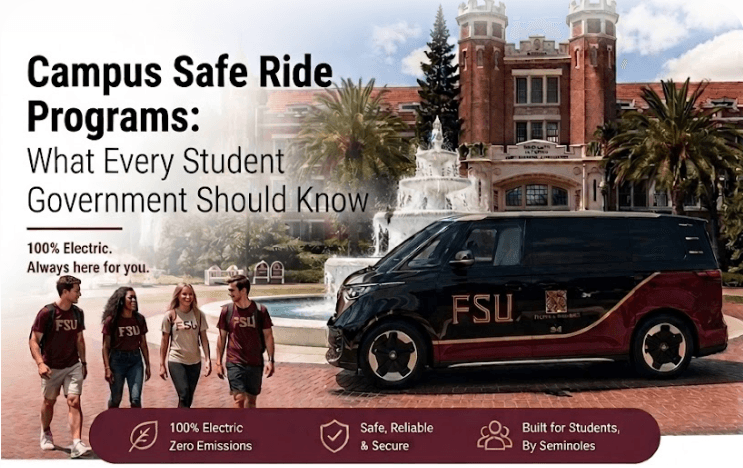
CatawbaGO operates a small fleet of electric low-speed vehicles appropriate for the speed environment around campus and downtown Salisbury. The vehicles are fully enclosed, climate-controlled, and branded with CatawbaGO and Catawba College identity. The 100% electric fleet produces zero tailpipe emissions, aligning with the college's sustainability mission.
The technology platform includes a dedicated CatawbaGO rider app available on iOS and Android. Students register with their Catawba email address, which also enables the college to track program utilization by student population segment. The app provides real-time vehicle tracking, estimated arrival times, and ride requesting for on-demand service. A web-based dashboard gives college administrators real-time visibility into ridership, service quality metrics, and utilization patterns.
Student Adoption and Usage Patterns
CatawbaGO's adoption curve exceeded projections. Within the first month of operation, over 40% of enrolled students had downloaded the app and taken at least one ride. By the end of the first semester, app adoption reached 62%, a figure that large universities typically achieve only after two or more years of operation.
The rapid adoption reflects several factors specific to small colleges. Word of mouth travels faster in a tight-knit community of 1,300 students. The student government actively promoted the service through social media and campus events. And the immediate, tangible benefit of free rides to destinations students want to visit created strong organic demand.
Usage patterns at Catawba follow a distinct rhythm. Weekday demand peaks between 5:00 PM and 10:00 PM as students head to dinner, evening activities, and study groups at downtown coffee shops. Weekend demand starts earlier, with afternoon rides to shopping and errands, building to an evening peak for dining and social activities. The highest single-day ridership occurs consistently on Fridays.
Community Impact in Salisbury
One of CatawbaGO's most significant outcomes is its impact on the broader Salisbury community. As the Biltmore Beacon reported, the service provides free point-to-point rides that connect students to downtown businesses. Several downtown Salisbury merchants have reported increased student patronage since the service launched.
PluginNC's coverage highlighted the "electric rideshare buzz" generated by CatawbaGO, noting that the program has raised awareness of electric vehicle technology in a community that had limited prior exposure. The visible, branded electric vehicles operating daily through downtown Salisbury serve as a rolling demonstration of practical EV deployment.
Catawba College's own communications have featured CatawbaGO prominently, highlighting the program as evidence of the institution's commitment to student experience and sustainability. The service has become a talking point in admissions conversations, with prospective students and families noting the availability of free electric transit as a meaningful campus amenity.
The Financial Model
CatawbaGO is funded through the college's student services budget, with a structure designed to be sustainable at Catawba's scale. The per-student cost is modest compared to the transportation programs at large universities, reflecting the right-sized fleet and service zone. The college views the investment through the lens of student retention and satisfaction rather than transportation cost alone.
For context, losing a single student to transfer costs a small college between $20,000 and $50,000 in lost tuition and fees. If CatawbaGO contributes to retaining even a handful of students who might otherwise transfer due to quality-of-life concerns, the program's ROI is strongly positive. While direct attribution is difficult to prove, early retention data has been encouraging.
Lessons for Other Small Colleges
CatawbaGO offers a replicable model for colleges in the 1,000-5,000 student range that want to add transit without building a full transportation department:
- Right-size from day one. A small fleet serving a focused service zone outperforms an overambitious program that spreads resources thin. CatawbaGO started with the routes and hours that matched actual demand, not aspirational demand.
- Partner, do not build. Catawba did not hire drivers, buy vehicles, or develop software. They partnered with Slidr to get a turnkey program that their staff manages at the oversight level, not the operational level.
- Connect campus to community. The decision to extend service beyond campus boundaries into downtown Salisbury was deliberate and essential. It transformed CatawbaGO from a campus circulator into a community connector, multiplying its value.
- Leverage the sustainability angle. For colleges with environmental commitments, an electric transit program is a visible, daily demonstration of those values. It gives the sustainability office a tangible story to tell.
- Involve students in design. Catawba's student government participated in route planning and promotion. Student buy-in from the start accelerated adoption and created a sense of ownership.
CatawbaGO proves that campus transit is not a function of institutional size. It is a function of institutional will. Catawba College had the vision, and Slidr had the platform to make it real.