 Mike Trombino, Founder

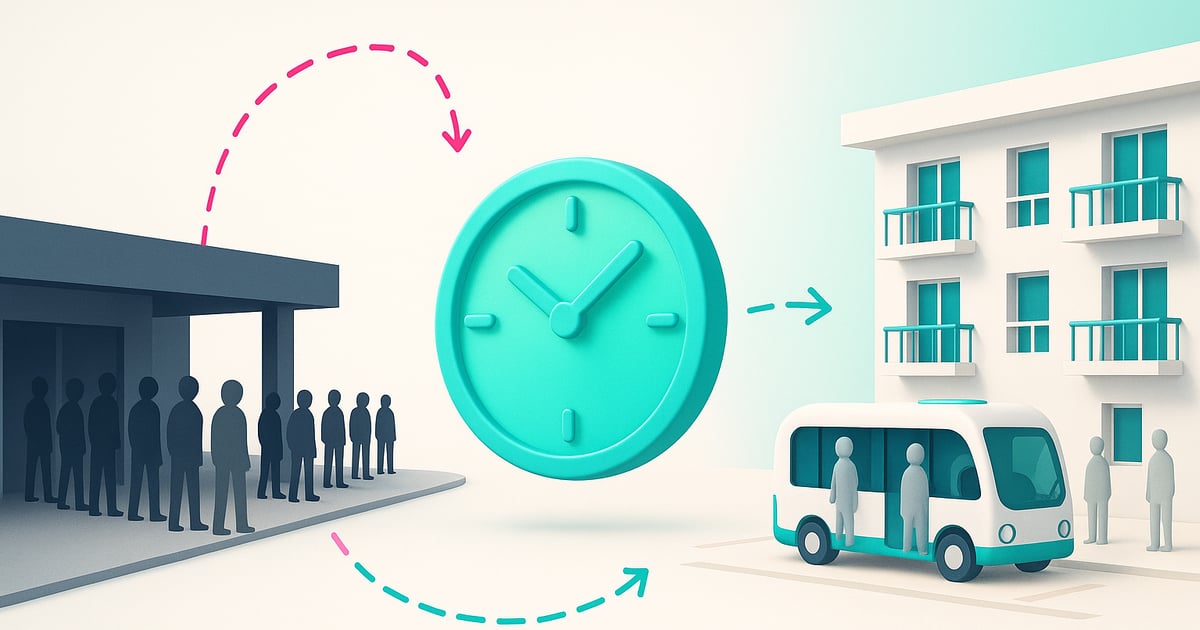
Guests often skip fixed shuttles for convenience.
Key takeaways
- On-demand rides eliminate schedule friction, improving guest satisfaction and program usage
- Fixed routes work for high-traffic corridors with dense, predictable demand; on-demand covers scattered destinations
- Many properties use both models strategically, reserving on-demand for flexibility and fixed routes for high-volume peaks
Hotel guests have clear preferences: convenience and speed. When a guest needs a ride from your property to the airport or a nearby attraction, they want it now, not on a schedule. Yet many hospitality properties still rely on fixed-route shuttles designed decades ago, often running under capacity because the schedule does not match how guests actually travel. Understanding the difference between fixed-route and on-demand models, and when each makes sense, is essential to designing a transportation experience that guests will use and that supports your operational and revenue goals.
What is the real difference between fixed-route and on-demand hotel shuttle alternatives?
A fixed-route shuttle follows a set schedule and path. It departs on a repeating cycle from the hotel, stops at key destinations, and returns. Guests know the schedule in advance; operations are predictable; your team plans around known commitments. But a guest arriving between scheduled departures will find another option, often a rideshare or taxi, costing money that could have stayed within your property ecosystem.
An on-demand ride works like a private car service for individual requests. A guest opens an app or calls the front desk, requests a ride, and one arrives when needed. The vehicle only deploys when summoned. Operationally, this requires active dispatch, available vehicles, and real-time technology to match requests to capacity. The trade-off is flexibility and guest satisfaction in exchange for tighter operational coordination.
Many properties operate both. A fixed route handles the predictable morning airport demand; on-demand picks up the afternoon and evening requests, the guest returning early from a conference, the family needing a last-minute ride to dinner. This hybrid approach allocates resources where demand actually exists.
Which model drives higher utilization and guest satisfaction?
Fixed-route shuttles are efficient at one thing: moving groups on a single vehicle during peak windows. When demand aligns with the schedule, vehicles fill and operate at high capacity. But utilization outside those peaks often falls dramatically. A large shuttle running off-peak routes frequently carries far fewer passengers than its capacity, resulting in expensive resources deployed underutilized.
On-demand models flip the equation. Small vehicles, each serving requests as they arrive, may run at higher utilization rates during off-peak hours because you are not holding large capacity to a schedule. A van sits parked until summoned, then operates only when revenue-generating. However, scaling on-demand across a high-volume property requires investment in dispatch technology, driver coordination, and enough vehicles to meet concurrent requests without excessive waits.
Guest satisfaction tends to favor on-demand because it eliminates schedule friction. A property operating on-demand transit can optimize the guest experience around their actual timing, not the shuttle clock. That convenience often translates to higher program usage and fewer guests booking external transport outside your ecosystem.
What factors should drive your hotel shuttle alternative decision?
The right choice depends on four things: geography, demand patterns, operations, and brand positioning.
Geography. If your hotel is near an airport or a major attraction with dense, predictable guest traffic, a fixed route serves that corridor efficiently. If your guests scatter across multiple destinations, on-demand flexibility becomes more valuable. Properties in urban areas where guests default to rideshare may find a smaller on-demand fleet more cost-effective than running underutilized fixed shuttles.
Demand patterns. Hospitality properties see variable demand across seasons and days. Business hotels spike on certain weekdays; resort properties shift seasonally. On-demand scales to demand; fixed routes are fixed regardless of whether demand exists. Understanding your guest travel patterns is essential to choosing a model that works.
Operations and staffing. Fixed routes require fewer management touchpoints: schedule them once, assign drivers, repeat. On-demand requires real-time coordination, a tech platform, and active dispatch. If your property has a small front desk team, fixed routes may be simpler to support. If you have dedicated guest services staff and strong internal coordination, on-demand becomes operationally viable.
Brand and positioning. Luxury properties often position private or semi-private transport as a guest amenity, signaling premium service. An on-demand experience aligns with that positioning. Budget properties may use fixed routes to control costs. Mid-market properties often adopt hybrid models to balance cost and guest expectation.
| Factor | Fixed-Route Shuttle | On-Demand Rides |
|---|---|---|
| Peak utilization | High, when demand matches schedule | Scales with actual demand |
| Off-peak utilization | Low, excess capacity | Higher, vehicles deploy as needed |
| Guest convenience | Moderate, guests must align with schedule | High, guests request when needed |
| Operational complexity | Low, schedule-driven | High, real-time coordination required |
| Best for | Predictable high-volume corridors | Variable destinations and timing |
How do electric vehicles fit into hotel shuttle alternatives?
Both fixed-route and on-demand fleets can be electric. The advantage is operational, not model-specific. Electric vehicles cost less to fuel and maintain, produce no tailpipe emissions, and often qualify for grants or incentives that reduce upfront cost. An electric on-demand fleet may benefit from lower per-mile costs and simpler maintenance, freeing resources for better dispatch technology or expanded service hours. A fixed electric shuttle reduces operating costs and aligns with sustainability brand positioning.
The choice between fixed and on-demand is separate from electrification. But going electric often makes both models more financially sustainable, especially when operating smaller, purpose-built vehicles rather than traditional large shuttles.
The right transportation model is not about the vehicle type; it is about matching supply to how your guests actually travel.
What does it take to improve or launch a hotel shuttle program?
Redesigning hotel transportation requires three things: clear data on guest behavior, realistic operational capacity, and a partner with experience running these programs at scale. Many properties make decisions based on past practice rather than current guest behavior.
Understanding your current program, who uses it and how, destination patterns, and guest feedback is the foundation. Are guests using the existing model, or are they booking alternatives? These signals tell you whether your approach is working.
Slidr partners with hotels and resort properties to operate complete on-demand or fixed-route programs, power existing vehicles and drivers with modern dispatch technology, or improve programs already running. Your property keeps its brand and runs the service under your name and app; Slidr handles operations, dispatch, and performance behind the scenes. Whether you are starting from scratch or optimizing an existing program, the goal is a transportation experience that works for your guests and your operations.
Learn more about hotel and resort transportation solutions, or book a property ride review to discuss your specific needs. For more detail on how Slidr powers transportation programs, see why hotels and universities choose Slidr.
Frequently Asked Questions
Why would a hotel choose on-demand over a fixed shuttle route?
On-demand rides eliminate schedule constraints and meet guests when they need transport, improving satisfaction and reducing abandoned trips. Guest preference often translates to higher program usage and lower reliance on external rideshare services that take revenue outside your property.
Are fixed-route shuttles becoming obsolete?
No. Fixed routes remain efficient for predictable, high-volume corridors like airport runs or regular downtown shuttles. The best strategy for many properties is hybrid: fixed routes for peak volume, on-demand for flexibility and off-peak requests.
How much does it cost to run a hotel shuttle program?
Cost depends on fleet size, service hours, vehicle type, and operational model. A small on-demand fleet may cost less than a large fixed-route shuttle running underutilized. Discuss your project to understand what drives cost for your specific property.
Can a hotel shuttle program use electric vehicles?
Yes. Both fixed-route and on-demand fleets can be fully electric. Electric vehicles lower fuel and maintenance costs, produce zero tailpipe emissions, and often qualify for grants and incentives that reduce upfront investment.
What technology does a hotel need to run an on-demand shuttle?
On-demand requires dispatch software that matches guest requests to available vehicles in real-time, tracks arrivals, and communicates status. A guest-facing app or phone system, integrated with your hotel operations, enables seamless requests.
Sources
- Slidr hotel and resort transportation solutions, 2025. https://www.rideslidr.com/solutions/hotels/
- Slidr contact and property review, 2025. https://www.rideslidr.com/contact/