 Slidr Team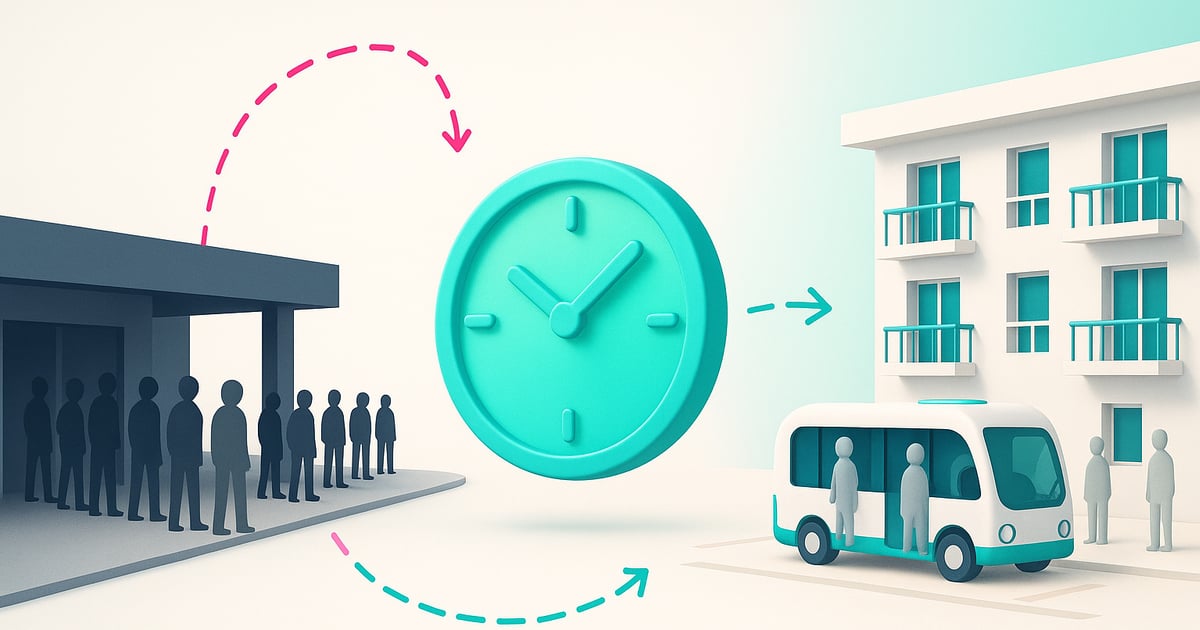
In our experience, real-time wait times build trust with first-time shuttle riders and turn skeptical hotel guests into repeat riders.
Transparent Wait Times Drive Adoption Among Skeptical Guests
Transparent wait times convert skeptics into repeat shuttle riders by replacing uncertainty with data-backed confidence. When a hotel guest knows exactly when their shuttle will arrive, they stop worrying about being stranded and start trusting the service. Real-time wait time visibility eliminates the friction that kills first impressions, turning a skeptical guest into someone willing to use the shuttle again. This shift from doubt to confidence is the foundation of sustainable ridership growth.
At Cove Inn in Naples, Florida, where the hospitality shuttle prioritizes short wait times, we have seen this principle at work. In our experience, guests who can see live wait time estimates in the app decide to ride quickly, rather than defaulting to a rental car or rideshare. When wait times are hidden or guests have to call the front desk to guess, skepticism grows and riders disappear.
The psychology is straightforward: opacity breeds doubt, and doubt breeds avoidance. Transparency breeds trust, and trust breeds repeat behavior.
Why Guests Default to Skepticism About Hotel Shuttles
Hotel guests arrive tired, often unfamiliar with the property, and naturally skeptical about any service they have not used before. A shuttle that will take a long time to arrive feels broken if guests do not know the actual arrival window. The same wait duration feels reasonable if guests saw a realistic estimate the moment they opened the app.
Without transparency, guests fill the information vacuum with worst-case assumptions. They assume the shuttle is unreliable, infrequent, or operated by a company that does not care about their time. These assumptions drive them toward alternatives, even if those alternatives are more expensive or less convenient.
When wait times are visible and accurate, guests make a different choice. They see that the shuttle is faster than a walk to the parking lot, or faster than calling a cab. The shuttle stops being a mystery and becomes a rational option.
Real-Time Data Removes the "Hope and Pray" Element
Opacity forces guests into hope-and-pray mode. They request a shuttle and then wonder whether it is coming, whether they should give up and call a rideshare instead, or whether they should have just rented a car. Every minute of uncertainty is a minute the guest's confidence erodes.
Real-time wait time transparency replaces that anxiety with clarity. Guests see the shuttle is approaching, and they know what to do: they can grab their luggage, alert the front desk, or step into the lobby and wait with confidence. They are no longer in limbo.
This clarity matters especially for hotel guests who are time-sensitive. A guest heading to an airport, a conference, or a dinner reservation needs to know the shuttle will get them there on time. If the app shows an accurate wait time and the shuttle arrives as promised, the guest's trust in the service deepens. If wait times are invisible and the shuttle shows up late, skepticism calcifies into a decision never to use it again.
Comparison: Transparent vs. Opaque Wait Time Models
| Aspect | Transparent Wait Times (Real-Time ETA) | Opaque Wait Times (No ETA) |
|---|---|---|
| Guest confidence at request time | High. Guest sees actual wait and can plan accordingly. | Low. Guest must guess or call front desk for an estimate. |
| Perceived reliability | Service appears dependable and professional. | Service appears unpredictable or outdated. |
| First-time rider conversion to repeat use | High. Positive first experience due to clear expectations. | Low. Uncertainty creates negative impression even if wait was reasonable. |
| Guest communication burden | Low. App and push notifications reduce phone inquiries. | High. Front desk fielding constant "where is my shuttle?" calls. |
| Operational feedback loop | Visible data on what guests expect vs. what they experience. | Invisible. No data on why guests choose alternatives. |
| Competitive positioning | Hotel appears modern, guest-centric, and invested in experience. | Hotel appears to offer shuttle only as checked box, not priority. |
What Ridership Tells Us About Transparency
In our experience, riders who can see when their shuttle will arrive come back more often than riders who are left guessing. Informed riders make repeat decisions; uninformed riders tend to become one-time users who switch to alternatives.
CatawbaGO at Catawba College in Salisbury, North Carolina runs two fully electric vehicles, and CatawbaGO riders rate the service 4.95 out of 5. In its Spring 2026 semester, CatawbaGO completed 6,396 rides and carried 8,126 passengers. In our experience, riders keep coming back like this when service is dependable and they know what to expect.
For hotel guests, the same principle applies. A guest who uses the shuttle once with a clear wait time estimate is far more likely to use it again than a guest who experienced uncertainty on the first trip. Over the course of a year, the difference in repeat usage can be substantial.
Building a Trustworthy Shuttle Program With Visibility
Transparent wait times are only credible if they are accurate. A system that consistently overpromises on arrival time will lose trust faster than a system with no estimates at all. This is why accurate data and realistic modeling matter more than fancy app features.
A turnkey shuttle operator like Slidr provides real-time dispatch, live GPS tracking, and predictive ETA algorithms that feed into the guest-facing app. Guests see a wait time that reflects actual vehicle location and traffic conditions, not an arbitrary number. When the shuttle arrives as promised repeatedly, skepticism transforms into reliance.
Hotels that want to maximize their shuttle adoption should prioritize accuracy and transparency over volume or coverage. In our experience, a small shuttle network with visible wait times earns more repeat riders than a larger network that hides them. Word of mouth from satisfied repeat riders carries further than any marketing promise.
Frequently Asked Questions
If we show guests real-time wait times, won't they get upset if the wait is long?
Transparency actually reduces frustration because guests can make an informed choice. If a guest sees a realistic estimate and decides to use the shuttle anyway, they accepted that wait. If they choose a rideshare instead, that is fine; better they discover this via data than discover it by waiting blindly at the curb. The key is that the wait time must be accurate and the shuttle must deliver as promised.
Can a hotel shuttle achieve repeat ridership without showing wait times?
It is possible, but much harder and slower. Hotels would need to build trust through consistent, excellent service over many months before guests would develop confidence. In our experience, transparency shortens that timeline a great deal, and guests who have a positive first experience with clear wait times are ready to ride again. Without transparency, many skeptical guests never give the shuttle a second chance.
What if our shuttle network is small and wait times are sometimes long?
Honest wait times, even long ones, are better than hidden wait times. Cove Inn in Naples operates a shuttle with short wait times, and that transparency is a competitive advantage. But any hotel can build trust by being honest about capacity constraints. Guests respect honesty more than they resent a long wait if they chose it knowingly. Transparency also gives you data on where demand exceeds supply, so you can make informed decisions about fleet size or service hours.
Conclusion
Transparent wait times are not a luxury feature for hotel shuttles; they are the foundation of ridership growth. When guests know exactly when their shuttle will arrive, they shift from skepticism to confidence, and from one-time users to repeat riders. In our experience, hotels that invest in real-time tracking, accurate ETAs, and guest-facing transparency see shuttle use grow as each satisfied guest becomes more willing to ride again. As guests come to expect digital transparency across the services they use, we expect hotels that hide shuttle wait times to find themselves at a disadvantage. The future belongs to properties that treat shuttle visibility as a core part of the guest experience.