Every university administrator knows the parking problem. Students complain there are not enough spaces. Faculty complain they cannot park near their buildings. Visitors give up and leave. Meanwhile, the university is spending $25,000 to $40,000 per space to build structured parking, consuming capital that could fund classrooms, laboratories, or student services. The National Parking Association estimates that U.S. universities collectively spend over $4 billion annually on parking infrastructure, a figure that has grown 8-10% per year for the past decade.
The traditional approach to campus parking has been straightforward: when demand exceeds supply, build more supply. But this approach has reached its limits. Land is finite, construction costs are rising, and every acre devoted to parking is an acre that cannot be used for the academic mission. Universities need a fundamentally different approach, and the good news is that several proven strategies can significantly reduce parking demand without reducing campus accessibility.
Understanding the Real Problem
Before discussing solutions, it is important to understand what the campus parking problem actually is. It is not, as commonly believed, a supply problem. Most universities have parking utilization rates of 70-85% across their entire inventory. The problem is that utilization is concentrated: a small number of high-demand lots near academic buildings are at 100% capacity while peripheral lots sit at 40-50%.
This is a distribution problem, not a supply problem. The solution is not more parking. It is better connectivity between where cars are and where people need to be.
A 2019 study by the Transportation Research Board found that universities could reduce the need for close-in parking by 30-40% if they provided reliable, frequent transportation between remote parking areas and campus destinations. The key word is "reliable." Previous university shuttle systems often failed because they ran on fixed schedules with long headways, making them unreliable and time-consuming. A student who has to wait 20 minutes for a shuttle bus will never voluntarily park in a remote lot.
Solution 1: Remote Parking with Shuttle Connectors
The highest-impact strategy is to convert existing underutilized surface parking into designated remote lots and connect them to campus with high-frequency shuttle service. The model is simple: drivers park in a remote lot, board a shuttle within 3 to 5 minutes, and arrive at a central campus location within 10 minutes. The total door-to-destination time is comparable to circling for parking in a close-in lot.
For this model to work, the shuttle service must meet three criteria:
- Frequency: Headways of 5 minutes or less during peak hours. Anything longer and users will perceive the service as unreliable and revert to driving to close-in lots.
- Reliability: Real-time tracking via mobile app so users know exactly when the next vehicle will arrive. Uncertainty is the enemy of adoption.
- Comfort: Vehicles must be clean, climate-appropriate, and comfortable. Asking people to stand on a crowded bus for 10 minutes is not a viable alternative to a private car.
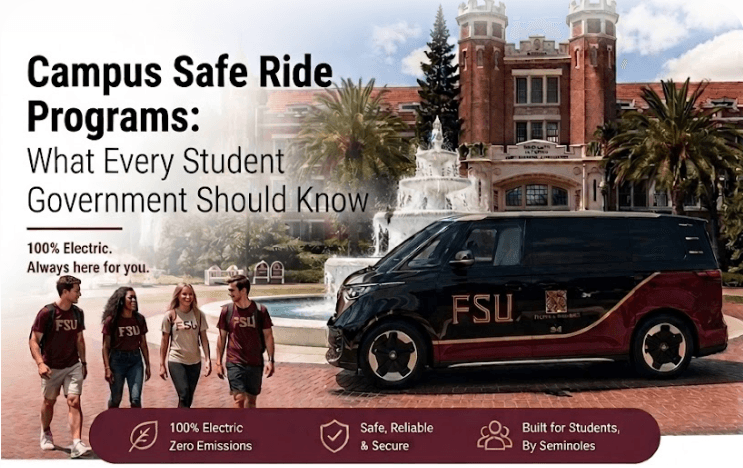
Electric low-speed vehicles are ideal for this application. They are quiet enough to operate through campus without disrupting outdoor spaces, they cost a fraction of what diesel buses cost to operate, and they can run continuous loops on short routes without range concerns. A fleet of 6 to 8 electric shuttles running 3-minute headways on a 2-mile loop can transport 300 to 400 passengers per hour, enough to fully service a 1,500-space remote parking lot.
The financial case is compelling. Building a 1,500-space parking structure costs approximately $37.5 million at $25,000 per space. Operating a shuttle connector that allows existing remote surface parking to serve the same demand costs approximately $250,000 to $400,000 per year. Even over a 30-year structure lifespan, the shuttle approach costs less than 30% of the construction alternative.
Solution 2: Demand-Responsive Campus Transit
Beyond parking connectors, universities benefit from campus-wide demand-responsive transit that serves the broader mobility needs of students, faculty, and staff. Traditional campus bus systems run fixed routes that were designed decades ago and may not reflect current campus geography or demand patterns.
Modern microtransit platforms can dynamically route vehicles based on real-time demand. A student requests a ride from the engineering building to the recreation center. The system routes the nearest available vehicle, potentially picking up other riders along the way. The student gets a ride in 3 to 7 minutes without walking to a fixed bus stop or waiting for a scheduled departure.
This model is particularly effective for campuses that have expanded geographically over time, adding satellite buildings, research parks, and athletic facilities that are poorly served by legacy bus routes. Demand-responsive transit adapts to the campus as it exists today, not as it was laid out 40 years ago.
Solution 3: First-Year Car Restrictions with Transit Alternatives
Over 40% of U.S. universities now restrict or prohibit first-year students from bringing cars to campus. These policies are effective at reducing parking demand, but they must be paired with viable transit alternatives to avoid creating a mobility gap for affected students.
The most successful implementations combine car restrictions with comprehensive transit programs: campus shuttles, partnerships with local transit agencies, bike share programs, and ride-credit systems for occasional car needs. When students have reliable alternatives, compliance with car restrictions is high and satisfaction with campus mobility actually improves.
At universities where first-year car restrictions have been implemented alongside transit alternatives, campus parking demand has decreased by 15-20%, enough to defer or eliminate a planned parking construction project and redirect that capital to academic priorities.
Solution 4: Bicycle and E-Bike Infrastructure
For trips under two miles, bicycles and e-bikes are the fastest and most space-efficient transportation mode. A single car parking space can accommodate 8 to 12 bicycles. A surface lot that parks 200 cars could park 2,000 bikes. The spatial efficiency is transformative for land-constrained campuses.
E-bikes are particularly relevant because they eliminate topography as a barrier. Campuses built on hilly terrain see low cycling rates because students are unwilling to arrive at class sweaty and winded. E-bikes with pedal assist solve this problem entirely, maintaining cycling speeds of 15-20 mph with minimal physical effort.
Universities that have invested in bike and e-bike infrastructure, including secure storage, covered parking, maintenance stations, and campus-wide bike share programs, have seen mode shifts of 5-15% from driving to cycling. On a campus with 20,000 daily commuters, a 10% mode shift eliminates 2,000 car trips per day and the associated parking demand.
Solution 5: Pricing and Policy Levers
Many universities underprice close-in parking, creating artificial demand. When a premium lot adjacent to the engineering building costs $400 per semester and a remote lot costs $200, the price differential is not sufficient to change behavior. The cost of circling for parking, being late to class, and the stress of the close-in experience would need to be reflected in a much larger price gap to shift demand to remote lots.
Universities that have implemented dynamic pricing, charging significantly more for high-demand close-in lots and offering substantial discounts for remote lots with shuttle service, have seen meaningful demand redistribution. Some have gone further, offering free remote parking for anyone who commits to using the shuttle system, funded by increased revenue from premium close-in spaces.
The political sensitivity of parking pricing on university campuses is real, and we do not underestimate it. But the alternative, spending tens of millions on new parking construction, is a much larger financial decision with much longer-term consequences. Pricing reform paired with genuine transit alternatives is the more sustainable path.
An Integrated Approach
No single solution solves the campus parking problem. The most effective approaches combine multiple strategies: remote parking with shuttle connectors, demand-responsive campus transit, bike and e-bike infrastructure, first-year car restrictions, and pricing reform. Each element reinforces the others, creating a mobility ecosystem that reduces parking demand while improving overall campus accessibility.
At Slidr, we have seen how electric shuttle service can be the connective tissue that makes the other strategies work. Remote parking only works if the shuttle is reliable. Car restrictions only work if students have alternatives. Pricing reform only works if the remote lot experience is genuinely convenient. The shuttle service is the enabling infrastructure that gives the rest of the strategy credibility.
For university transportation directors and campus planners interested in exploring how electric microtransit fits into their parking and mobility strategy, we bring both operational expertise and a data-driven approach to route planning and demand analysis. The campus parking problem is solvable. It just requires thinking beyond the parking structure.