 Slidr Team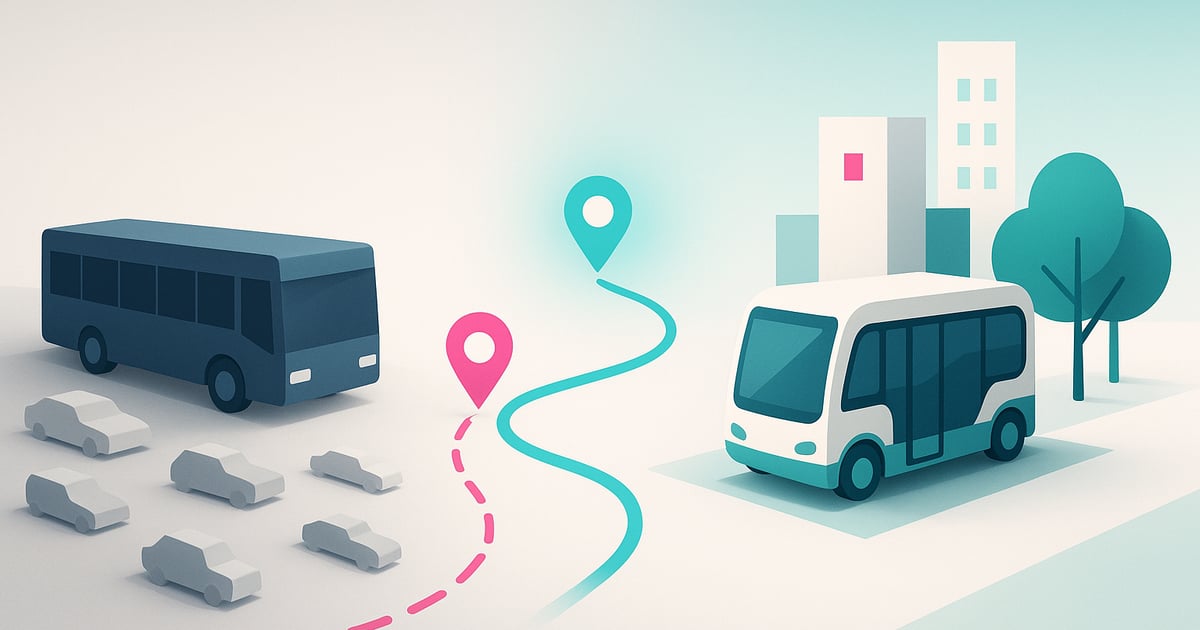
Microtransit and traditional public transit serve different needs. Microtransit wins for flexibility and coverage; fixed-route transit wins for high-volume corridors and established demand patterns.
Microtransit and traditional public transit represent two distinct approaches to moving people, and neither has made the other obsolete.
Microtransit refers to smaller-scale, flexible transit services that operate on-demand or follow semi-flexible routes, typically serving a defined area with lighter ridership or variable patterns. Traditional public transit, by contrast, runs fixed routes on published schedules, designed for predictable demand corridors and higher volumes. Each model excels in different contexts, and the question is not which one is better overall, but which one solves the specific problem in front of you.
The choice between them hinges on demand patterns, geography, budget constraints, and organizational capacity. A university cannot ignore its core commute corridors any more than a master-planned community can justify fixed buses running empty on nights when residents stay home. Understanding where each model wins, and when they can coexist, is essential for anyone planning a transportation program in 2026.
Where Traditional Public Transit Excels
Fixed-route public transit remains unbeatable for high-volume, predictable corridors. When tens of thousands of people move between the same two points on roughly the same schedule (downtown to a train station, airport to downtown, suburb to urban core), the economics and logistics of fixed routes make sense. Buses run full. Riders know the schedule. Infrastructure is amortized across many trips.
Public transit also carries social and political weight. It defines a region's commitment to accessibility and reduces dependency on personal vehicles. Where demand is dense and concentrated, it delivers the throughput and affordability that microtransit cannot match.
But fixed routes have a hard boundary: they require sufficient demand. Where demand is sporadic, geographically dispersed, or time-sensitive, fixed buses run partially full or empty. They cannot adapt to sudden changes in origin or destination patterns. They do not serve late-night commutes or non-traditional schedules well. They work for the predictable; they fail at the flexible.
Where Microtransit Wins: Flexibility, Coverage, and Rider Experience
Microtransit thrives precisely where fixed routes struggle: in environments where demand is unpredictable, dispersed, or episodic. On a college campus, students leave their dorms at different times, heading to different buildings. At a hospitality property, guests arrive and depart on different schedules. In a planned community, evening and weekend travel patterns vary widely.
On-demand microtransit eliminates the "last mile" wait problem. Instead of checking a schedule and arriving early, riders request a trip and know when to expect pickup. CatawbaGO, the on-demand shuttle at Catawba College in Salisbury, North Carolina, completed 11,051 rides and carried 14,588 passengers by August 2026, with riders rating the service 4.95 out of 5. That satisfaction reflects not just the ride itself, but the control it gives passengers over their own time.
Microtransit also serves populations and geographies that fixed routes cannot justify. A small college cannot sustain fixed-route buses to every academic building. A hotel property does not need a published schedule when guests arrive at unpredictable times; guests need a ride available now. A community with modest demand spread across multiple neighborhoods cannot afford the overhead of structured routes and long off-peak waits.
The flexibility of microtransit also enables rapid response to changing conditions. When the University of North Alabama switched UNA Roar Ride from a fixed route to on-demand service mid-year in October 2023, ridership doubled. The service had not changed; the model had. On-demand simply matched how students actually traveled.
Comparison: On-Demand vs Fixed-Route Service Models
| Characteristic | On-Demand Microtransit | Fixed-Route Public Transit |
|---|---|---|
| Best for | Dispersed demand, flexible schedules, campus or community environments | High-volume corridors, predictable commute patterns, airport or downtown connections |
| Rider control | Request trip in real time; know pickup window immediately | Plan around published schedule; wait for next departure |
| Vehicle utilization | Routes are dynamic; vehicles follow demand instead of empty routes | Fixed routes ensure consistent schedule; efficiency depends on demand density |
| Coverage area | Can serve geographically dispersed zones with lighter investment | Most economical in tight corridors with dense stops |
| Implementation timeline | Faster deployment; fleet and technology can launch in weeks | Longer planning and infrastructure phase; requires route design and community input |
| Scaling capacity | Easy to add vehicles and zones as demand grows | Requires redesign and investment to expand beyond core routes |
Real-World Deployments Show the Distinction
FSU Safe Ride in Tallahassee operates a large-campus safe-ride service for a major university. The service must cover dozens of buildings and tens of thousands of students across unpredictable schedules. On-demand microtransit fits that mission better than fixed routes ever could.
By contrast, a city with a single fixed-route bus might work well for a small, tightly bounded service area like the City of Oberlin, Ohio, where infrastructure and demand are concentrated enough to sustain a simple line. Yet even there, the shift in work schedules, school hours, and evening demand means purely fixed transit leaves gaps.
Cove Inn in Naples, Florida, demonstrates microtransit in a hospitality context. Guest arrivals and departures happen around the clock and on no fixed schedule. A published shuttle schedule would leave guests waiting or missing connections. On-demand service means they call, book, and ride within a predictable window.
Tradition TIM, connecting a master-planned community in Port St. Lucie, Florida, operates in another context where population is distributed across an area too large for a single fixed route but too dispersed for public transit economics. On-demand microtransit serves residents when they need it without the overhead of fixed schedules.
When Hybrid Models Make Sense
Not every transportation system must choose one or the other. Some organizations run both: a high-frequency fixed route for peak commute corridors, plus on-demand service for off-peak, late-night, or less-predictable travel. A large university might have a fixed bus line connecting major transit hubs during rush hours, with on-demand service filling the gaps during off-peak times and serving dispersed origins and destinations.
The technology and operational structure differ, and adding both requires more vehicles and coordination. But the outcome can be superior to either alone: you get the efficiency of fixed routes where demand warrants it, and the flexibility of on-demand everywhere else.
Frequently Asked Questions
Should we replace our fixed-route bus with an on-demand shuttle?
Not necessarily. If your fixed route carries high volume during predictable hours, it works and should be preserved. Evaluate which times run full and which run empty. If ridership is strong during core hours but thin during evenings or weekends, you might add on-demand service to complement the fixed route rather than replace it. The decision depends on your actual demand data, not on which model sounds more modern.
We're a small property or community. Do we need a big shuttle system at all?
Scale matters less than need. A small property with low travel demand might run a single on-demand vehicle a few hours per day. A small community with dispersed residents might do the same. The question is whether your users would benefit from the convenience and coverage you can provide. If the answer is yes, start with what you can afford and add capacity as demand justifies it.
What's the learning curve for launching a new transit service?
If you have vehicle and driver capacity in-house, adding technology and dispatch management is straightforward. If you need to build the program from scratch, that includes fleet procurement, driver recruitment and training, insurance, and operations setup. Some models enable you to operate a complete program end-to-end (vehicles, drivers, technology, maintenance, insurance, daily operations), others let you power an existing fleet with new technology and dispatch, and others focus on improving a service already running. The timeline depends on which approach fits your situation, but well-designed microtransit programs can launch in weeks, not months.
The Future Belongs to Adaptive Systems
The transportation challenge for universities, hospitality properties, and communities is no longer about choosing between microtransit and traditional transit. It is about understanding when each model works, and building systems flexible enough to adapt to changing demand. Fixed-route transit will remain essential on high-volume corridors. Microtransit will continue to expand wherever demand is dispersed, seasonal, or time-sensitive. And the smartest organizations in 2026 will be those that layer both together, eliminating silos between them and letting demand determine which service operates when.